Episode 32 - Rounds & Partner Songs, Part 3 – Singing Around the World
Introduction
Welcome to Episode 32 of the Welcome to Music Podcast!
In Part 3 of the Rounds & Partner Songs series, Susie continues the musical journey around the world with three wonderfully different experiences for children aged 4–12.
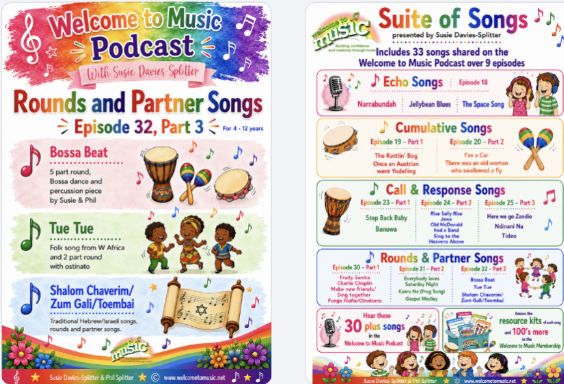
This time, the journey moves from the lively rhythms of Bossa Beat, to Ghana with Tue Tue, and then to a collection of traditional Hebrew/Israeli songs: Shalom Chaverim, Zum Gali Gali and Toembai.
Each provides a different pathway into part-singing. Children can begin by singing together in unison, then gradually add movement, body percussion, instruments, ostinati, rounds and partner parts as their confidence grows.
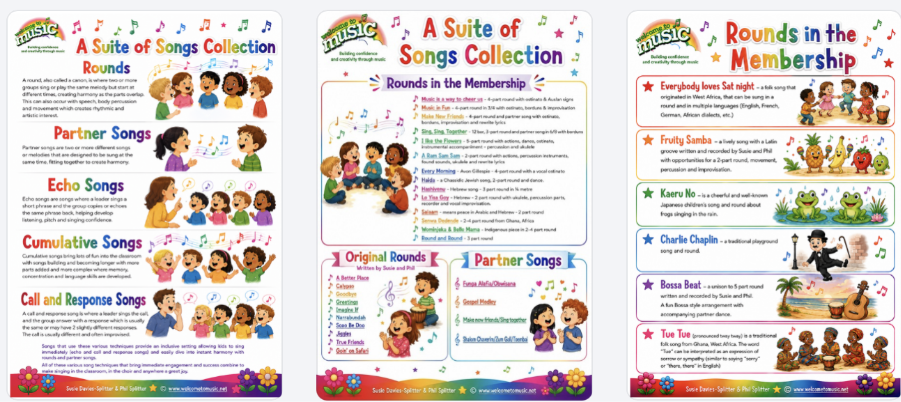
This episode continues the Welcome to Music Suite of Songs journey, exploring the many ways children can experience singing together through echo songs, call and response, cumulative songs, rounds and partner songs.
Songs that use these various techniques provide an inclusive setting allowing kids to have instant success, sing immediately (echo and call and response songs), easily dive into instant harmony with rounds and partner songs making singing in the classroom, in the choir and anywhere a great joy.
Why Rounds and Partner Songs?
Rounds and partner songs provide a wonderful bridge between singing a single melody together and singing in harmony.
In a round, everyone sings the same melody but begins at different times. In a partner song, two or more different melodies are designed to be sung at the same time.
Both encourage children to listen to the music happening around them while confidently maintaining their own part. Along the way they develop pitch, listening and concentration, musical independence, an understanding of harmony, ensemble skills and confidence in group singing.
The secret is to start simply. Learn each melody really well before adding another layer, and build the musical puzzle one piece at a time.
BOSSA BEAT
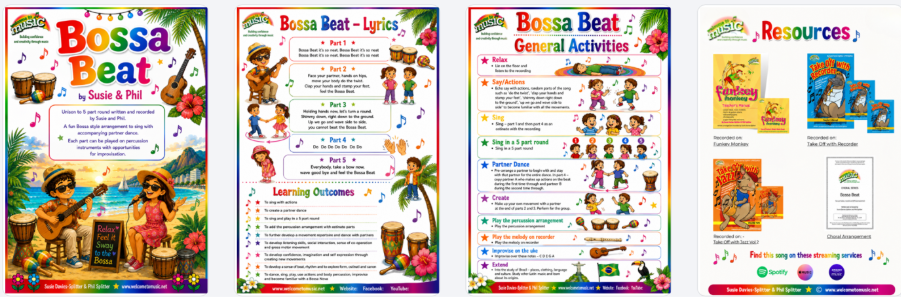
Bossa Beat is an original five-part round written and recorded by Susie Davies-Splitter and Phil Splitter, with a relaxed Bossa-style feel and plenty of opportunities to sing, move, play and improvise.
Each of its five short sections can be learned separately before being layered together as a five-part vocal round. Children can begin simply by singing the catchy melodies and adding the actions. As confidence grows, the song can develop into a partner dance, percussion arrangement or full five-part performance.
The accompanying movement is an important part of the fun. Children clap, stamp, twist, turn, sway and work with partners, giving them a physical way of feeling the beat and remembering each musical section.
There are also plenty of possibilities for instrumental work. The resource includes parts for xylophone or marimba, glockenspiel, metallophone, tambour and tambourine, shakers and Boomwhackers, together with ostinati and opportunities for improvisation. Children can explore the A lah pentatonic scale, create their own patterns and transfer vocal parts onto melodic instruments.
More confident groups can take the musical layering even further by combining singing, movement, dance, percussion, instruments, improvisation and the five-part round into one performance.
And for instrumental players, Bossa Beat can also be explored on recorder and ukulele, making it a terrific piece to revisit with different age groups and at different stages of musical development. The resource itself describes the progression from unison singing through to the five-part round, partner dance, percussion and improvisation.
Teaching idea: Don't introduce all five parts at once! Start with one, add the actions until it feels completely secure, then introduce the next. Gradually building the layers allows children to hear the harmony emerging around them without being overwhelmed.
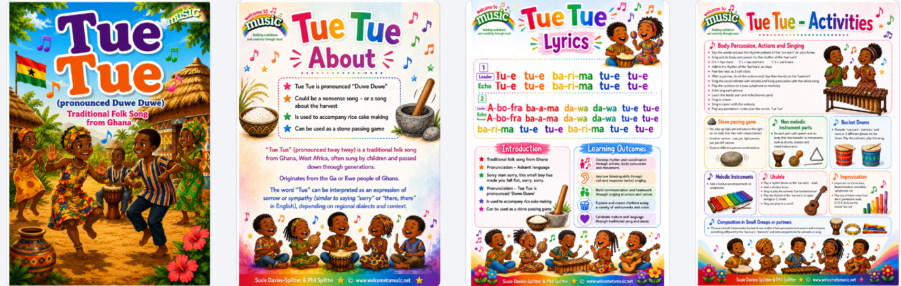
TUE TUE
Tue Tue is a traditional folk song from Ghana in West Africa. The Welcome to Music resource presents it as a wonderfully versatile song that can move from simple echo singing into a two-part round with an ostinato, while also opening the door to movement, rhythm, percussion and creative music-making.
One of the lovely things about Tue Tue is how naturally it lends itself to learning through the body. Begin with the words and rhythm, echoing short phrases and adding simple actions or body percussion. Once children know the song confidently, the rhythm can be transferred to drums, shakers, metal instruments, bucket drums or melodic percussion.
The resource also suggests using the song as a stone-passing game, giving children another playful way to experience its steady beat and rhythmic patterns. There are opportunities to add a bordun accompaniment on xylophones, create ostinati and improvise using notes from the C pentatonic scale.
For ukulele players, a rhythmic ostinato can accompany the repeated Tue Tue section, while another group maintains a vocal ostinato. More experienced groups can then sing the melody in a round while the ostinato continues underneath.
That progression makes Tue Tue particularly useful in a mixed-ability classroom. One group might maintain the beat, another play an ostinato, another sing the melody and another improvise. Everyone has a musical job, but the parts combine into something much richer than any one part alone. The activity page develops exactly these possibilities through body percussion, stone passing, non-melodic and melodic instruments, ukulele, improvisation and small-group composition.
Teaching idea: Teach Tue Tue first as an echo song. Once everyone can sing it independently, add the ostinato. Only then divide the group and try the round. That gradual layering turns what could feel difficult into a very achievable first experience of independent part-singing.
SHALOM CHAVERIM/ZUM GALI GALI/TOEMBAI
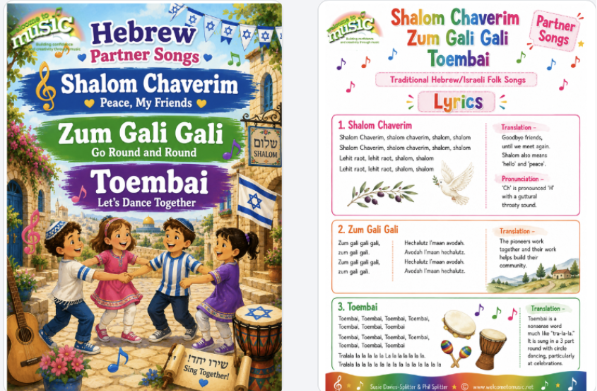
This collection brings together three traditional Hebrew/Israeli songs that can each stand beautifully on their own but can also be explored through rounds and partner singing.
Shalom Chaverim
Shalom Chaverim is a gentle farewell song. The resource translates its central idea as “Goodbye friends, until we meet again,” while also explaining that shalom can mean both hello and peace.
Its flowing melody makes it particularly lovely for developing sustained singing, phrasing and listening. Once children know the melody confidently, it can be sung as a round and later combined with the other songs.
Zum Gali Gali
Zum Gali Gali brings a contrasting rhythmic energy. The translation included in the resource describes pioneers working together and their work helping to build their community.
Its repetitive rhythmic pattern makes it accessible for children and particularly effective for maintaining an independent part while another melody is happening around it.
Toembai
Toembai provides another contrasting musical character. In the resource, Toembai is treated as a nonsense word, rather like “tra-la-la.” The song can be sung as a three-part round and is particularly suited to circle dancing and celebrations.
Together, the three songs provide a wonderful opportunity to move beyond a conventional round. First learn each song independently. Then explore them as rounds before beginning to combine the different melodies.
The magic happens when children realise that they are no longer simply singing the same song at different starting points. They can maintain completely different melodies simultaneously and hear those independent parts fit together musically.
The supplied arrangement places Shalom Chaverim, Zum Gali Gali and Toembai simultaneously as three partner-song lines, giving children a genuine experience of independent part-singing.
Teaching idea: Divide the class into three groups and let each group become the “experts” on one song. Perform them separately first, then try two songs together before attempting all three. Swap parts so children experience the different melodic and rhythmic challenges of each song.
One Song, So Many Possibilities
One of the joys of rounds and partner songs is that learning the melody is often just the beginning.
Once a song is familiar, it can become a springboard for so much more. Children can add movement and body percussion, transfer rhythms and melodies to instruments, create ostinati, improvise and gradually develop the confidence to maintain an independent part.
The possibilities can grow along with the children, allowing the same song to be revisited in new ways as their musical skills develop.
And that's exactly the idea behind the Welcome to Music Suite of Songs...
Explore the Suite of Songs
The songs featured in this episode are just the beginning! Our Suite of Songs brings together a colourful collection of rounds, partner songs, echo songs, cumulative songs and call & response songs, providing endless opportunities for singing, movement, part singing, percussion, improvisation and creative music-making.
Within the Welcome to Music Membership, you'll find a growing collection of rounds and partner songs from different cultures and musical styles, together with our own original songs and arrangements.
Each song can become the starting point for so much more than singing. Explore movement, dance, body percussion, instruments, improvisation, rounds, ostinati and part singing, with ready-to-use resources to help bring the music to life.
Discover the Complete Collection
Explore the Suite of Songs and access the complete resource kits in the Welcome to Music Membership. Try the Membership FREE for 7 days and start exploring!
Keep Singing!
Rounds and partner songs give children the opportunity to experience something quite magical: hearing different musical parts happening around them while confidently maintaining their own.
The songs in Episode 32 show just how many different ways that can happen. From the five interlocking parts of Bossa Beat, to the rhythms and ostinati of Tue Tue, and the beautiful combination of Shalom Chaverim, Zum Gali Gali and Toembai, each song offers a different pathway into harmony and independent singing.
Most importantly, children discover that part-singing doesn't have to be difficult. Begin simply, build one layer at a time and let them experience the joy of creating something together that no single voice could create alone.
LEARN MORE ABOUT THE WELCOME TO MUSIC MEMBERSHIP
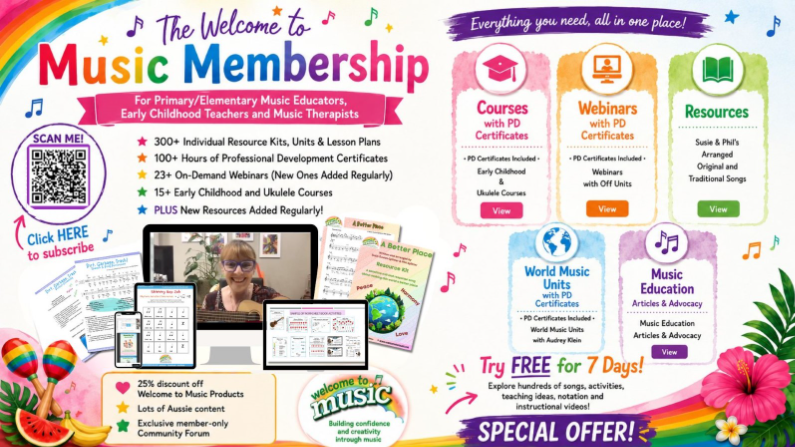
Imagine having a treasure trove of resources designed to make your teaching journey a breeze. The Welcome to Music membership is your ultimate toolkit for primary/elementary music educators, early childhood teachers, music therapists and anyone that uses music with children 0-12 years. Here’s what is inside:
✨ 100+ Hours of PD Certificates: Dive into our extensive library of on-demand courses and webinar replays, earning professional development certificates at your own pace.
🎤 Library of Webinars and Workshops: Unlimited access to our complete collection of webinars and workshops, packed with resources including topics such as: Bucket Drumming, Instruments in the Classroom, Games, Performance Ideas, Indigenous songs, Lilting lullabies & tranquil tunes, Story Songs, Folk Dances, World Music and many more, all with PD certificates
📚 Ready-Made Resource Kits: Over 250 lesson plans, activity sheets, and teaching resources to save you hours of prep time, including complete music notation with songs, dances, choral music, percussion arrangements, recorder pieces, ukulele accompaniments, music reading worksheets, arts and crafts, links to the curriculum and assessment and much more
💻 On-Demand Courses: Interactive courses covering everything from Music with Babies & Tots, Early Childhood Music to Advanced Ukulele!
👨🏫 Exclusive, Community Forum and member-only private Facebook group: Connect with a vibrant community of educators, share ideas, and receive continuous support from Susie, Phil, and the team.
💡 Always Fresh Content: New resources added regularly, and all webinars available shortly after they go live!
🦘 Lots of Aussie Content: A huge and growing collection of Susie and Phil’s original and traditional songs with added resources and instructional videos alongside resources from other notable Australian music and movement educators
🈹 25% Member Discount off Welcome to Music products: All members receive 25% off any physical or digital products (excluding Black Belt Ukulele products) in the Welcome to Music Store! https://welcometomusic.net/
Become a member of the Welcome to Music community today and enjoy all these fantastic benefits. Visit our Membership Page
Closing
This podcast has been brought to you by Welcome to Music – building confidence, creativity and enriching lives through the joy of music. In the show notes, you'll find links to a summary of this episode and our social media platforms. In the blog, you will find all the notes and links to this episode.
Our goal is to help make teaching and learning music easy and fun for all. I use an inclusive, multi-modal, multi-sensory and Orff-based approach to help make the learning stick.
- Find us at https://welcometomusic.net/
We would love you to subscribe to our YouTube channel where you can find almost 200 videos for kids – from lyric, play-along, instructional and animation videos www.youtube.com/c/WelcometoMusicSP
- Find 100’s of our songs on streaming platforms such as Spotify and Apple Music – just search for Susie Davies-Splitter & Phil Splitter or the song title
- Join us in the socials on Facebook and Instagram
Click the Links Below to Find Us on the Socials:
Click the Links Below to Find Our Music on These Platforms:
If you have enjoyed this podcast, please share it with others and leave a review – I’d really appreciate it.
Happy music-making! 🌈🎶
Susie & Phil, Welcome to Music
Episode 31 - Rounds & Partner Songs, Part 2 – Singing Around the World